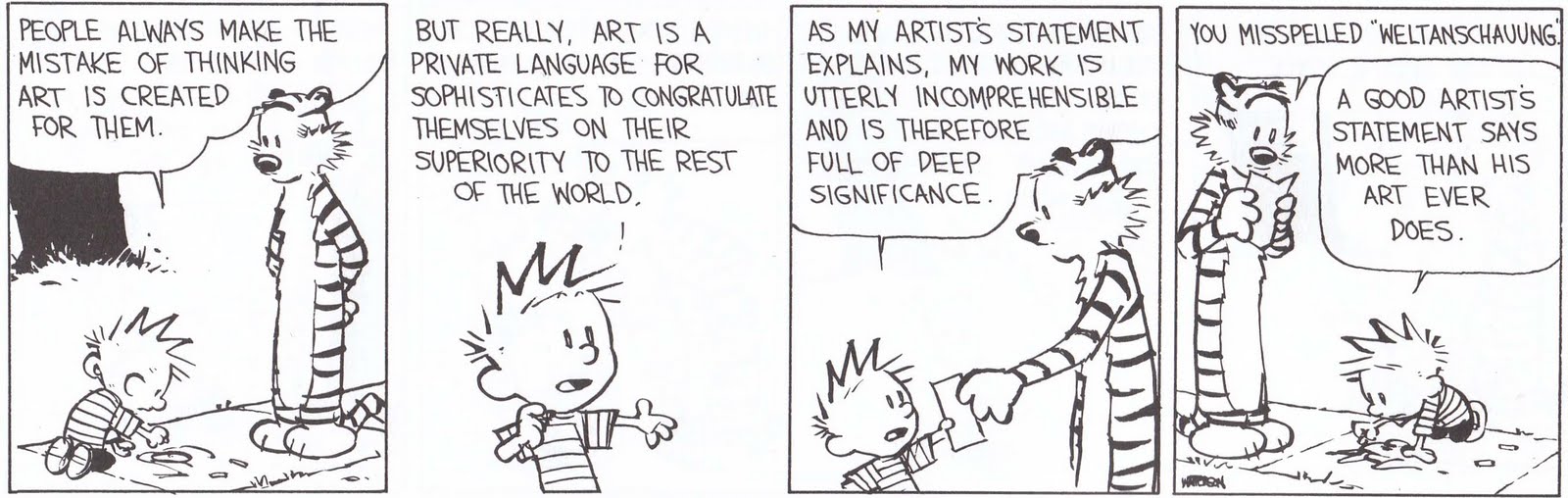
Calvin and Hobbes
Also Due
On the day this reading set is due, you will bring to class a completed artist statement and bio, printed out on a single sheet of paper to share and receive feedback. The artist statement should be between 100 and 200 words, and the bio should be 50 to 120 words. We will critique these in class. This assignment will not be submitted to the instructor yet, but will be part of a later assignment, so this is a chance to get feedback without the worry of grades… yet.
Why?
Artist statements and bios are a staple of making your art public. You will be asked for them by galleries and museums, granting agencies, and more. Learning how to write a solid, earnest, and honest artist statement that isn’t too coy, isn’t too obtuse, isn’t argumentative, and doesn’t fall into tropes can be tricky. Putting together a bio that is helpful, elucidating, and informative without being overly cute, banal, and/or predictable is equally difficult.
Required
How to Write an Artist Statement, The Creative Independent
“I like to think of the artist statement as the wedding toast of the art world. If you wing it, suddenly you’re on the spot in front of a crowd of expectant faces, trying to put into words a relationship (between you and your art) that you’ve always felt intuitively. We’ve all seen those toasts. They don’t go well.”
No Longer Interested
"Let’s imagine I meet a woman at a party and ask ‘so, what do you do?’ She answers, ‘I am interested in the body, healing, and science, and how those intersect within institutions and the public.’ Fascinating right? But why not cut to the chase and say you’re a medical doctor? In the non-art world, people talk about what they do. Describing what you’re doing instead of your interests moves the conversation forward. It’s more clear."
What We Learned from Writing 7,000 Artist Bios, Artsy
“Artsy has created over 7,000 artist bios, and over the years we’ve learned a few things about what our audience of collectors and art lovers finds valuable when discovering new art. Since Artsy’s partners can now add their own artist bios, we decided to take this opportunity to invite Jessica Backus, Director of Artsy Marketplace, to share some insights into what makes for a compelling bio and how to eloquently summarize an artist’s practice in 120 words.”
Supplementary Readings
- Artist Statements
-
Artist Statements: A Quick Guide, Community Arts Partnership
“Your artist statement is a written description of your work that gives your audience deeper insight into it. It may include your personal history, the symbolism you give your materials, or the issues you address; Your statement should include whatever is most important to you and your work. Your artist statement supplements the visual information in your portfolio. Other uses include the following: helping dealers and other arts professionals talk about and sell your work; providing background information for writers of articles, reviews, and catalogues; functioning as the basis for cover letters and grant proposals.”
- Artist Bios
-
How to Write an Appealing Artist Biography, Artwork Archive
“It weaves the story of your art career—instilling trust as it goes - allowing you to share your credentials and achievements without speaking a word. The importance and utility of this emissary cannot be stressed enough. Armed with this knowledge, all that’s left is to write and perfect your artist biography. Easy, right? Unfortunately, staring at a blank page trying to condense your art career into a paragraph or two is anything but. That’s why we’ve put together the five steps to writing an appealing artist biography, from start to strong finish, to get your creative juices flowing.”
- Artist Résumés / Curriculum Vitaes (CV)
-
Artist Résumé: Recommended Conventions, College Art Association
“The artist résumé conventions presented here are designed primarily for use in proposals to professional venues, which can include commercial and non-profit galleries, museums, and art centers. These recommendations can also be followed when submitting a résumé for grants, residency programs, commissions, and other exhibition opportunities. The artist résumé is increasingly used as an essential element on artist and gallery websites and may also be used in publications such as exhibition catalogues. Avoid making the artist résumé complicated; it is meant to be short and simple to review. Normally the artist résumé is succinct (one to four pages in length) and is similar to the short curriculum vitae or short CV.”
Response Questions
Select one question below to which you will respond. Remember to cite specific instances from the text to support your views.
- What are the key takeaways you got from this reading and why do you see them as applicable to you?
- Do you have a counterargument to Lambert’s “No Longer Interested?” Lay out your case for why language such as “interested” should still be a significant part of explaining artistic practice.