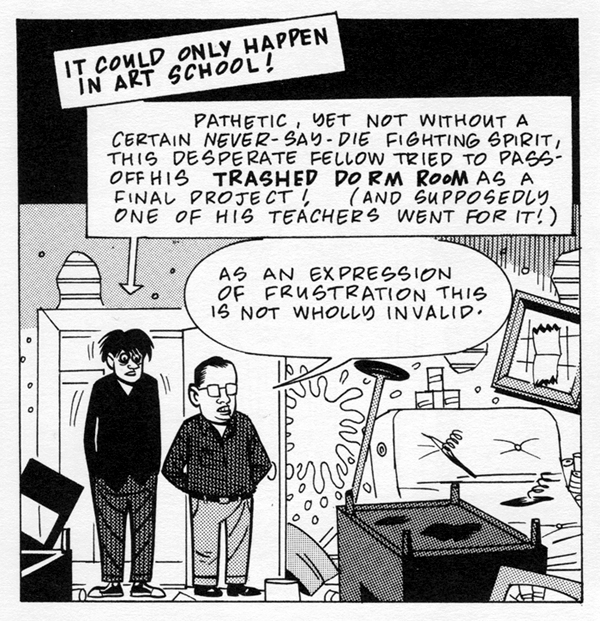
Daniel Clowes
Art School Confidential, 1991
Why?
Teaching is an enticing option for many artists. You get to work within you field and share in the excitement of creation and learning. You also often get time off based on the school schedule. There are pros and cons with any profession. We will read about and discuss many of these.
Required
Lessons I’ve Learned from Being a Teacher and an Artist, Venison Magazine
“This year I’m starting my fifth year as a full time art teacher at a large Bay Area public high school, and it has been 9 years since I began teaching. I am also a practicing and exhibiting artist. It has, at times, been a struggle to balance the demanding task of teaching and the time needed to develop ideas and execute creative projects. I am passionate about my role as an art teacher, and want to offer my students as many opportunities to develop their artistic skills and ideas as I can, but I also know myself and how important keeping my art practice alive is to me. I know so many teacher/artists who struggle as I do and we all have to find our own ways of striking the balance needed to engage fully with both teaching and making art. But over the years I have learned a few things that has made striking this balance easier; ways of thinking that are helpful to me as an artist that I teaching has taught me.”
Ask the Art Professor: How Can I Make the Transition to Teaching Art at the College Level?, HuffPost
“If you do decide to go down this path, it's important to know that while some colleges do advertise adjunct teaching positions, many do not. When I was at the beginning of my teaching career, I cast a wide net by writing letters of inquiry every year to a number of department heads at the local colleges. I was surprised that several department heads responded and kept my information on file for the future. In numerous cases, I was offered an adjunct position a few years later, and that's initially how I launched my teaching career. Additionally, network and milk your personal connections. I got my first teaching position because I met a department head at a printmaking conference when I was still a graduate student. He asked me to send him my materials, and within one year I had my first adjunct teaching position.”
Response Questions
Select one question below to which you will respond. Remember to cite specific instances from the text to support your views.
- What most surprised you in this reading set and why?
- Which principles do you see are being the most pertinent to your practice and why?
Supplementary Readings
These are optional readings to help enrich your understanding of the themes of this reading set.
- Teaching Art
-
How to Turn Your Art Practice into a Business, The Creative Independent
“Starting up a business is stressful. Once you have a solid idea that you’re excited to try out, there are some lame logistical business things you simply must do. They are overwhelming and distracting and it might be a good idea to ask your mother, your business-y friend, or someone else altogether to handle it. If you can’t do that, try SCORE—which provides free business mentorship—or, you can see if there are small-business classes in your community (often, there will be—google it!). These classes are always great to take. I took one with the Renaissance Entrepreneurship Center in San Francisco. They were great on so many levels, and had a 12-week class with a sliding-scale payment option. The class covered the basics of writing a business plan, and also coupled me with a mentor in the same field as me, which was really helpful.”
Towards a Self-Sustaining Publishing Model
Note: This essay has been lightly edited for BYU audiences. “Some things I have learned in over 30 years of publishing since my teenage days as a zine maker, administrating my project Public Collectors, and from working in the group Temporary Services and our publishing imprint Half Letter Press.” The original, unedited essay is found here: https://halfletterpress.com/sustaining-publishing/