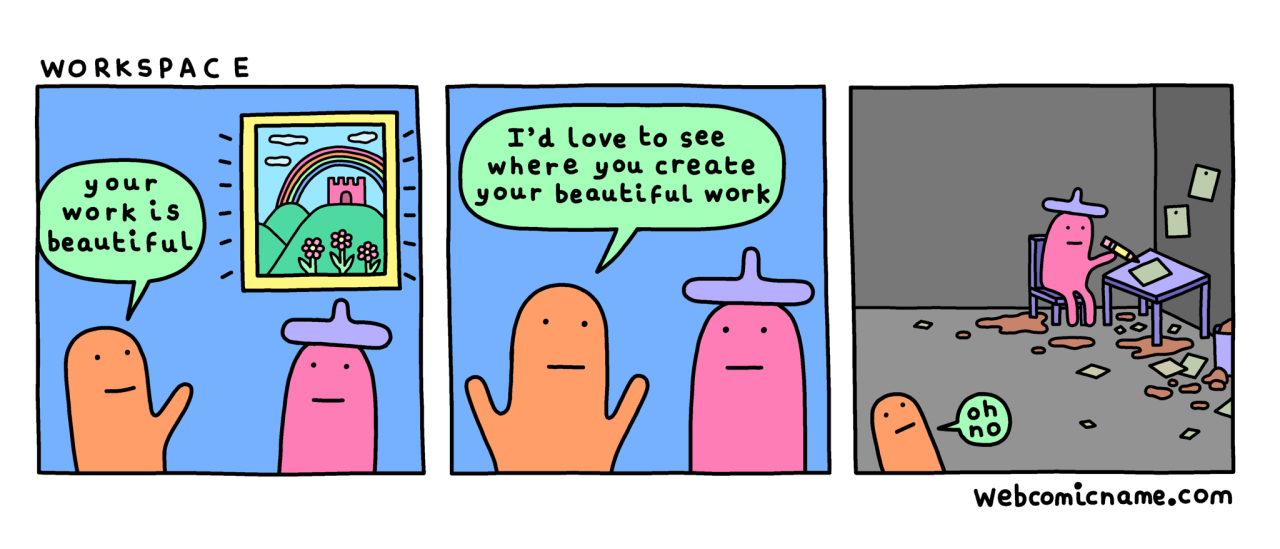
Webcomic Name: Workspace, May 18, 2023
Why?
You want to start getting more opportunities for your art. What do you do? One option is to invite people to see your work at exhibitions, your studio, and other pertinent locations. You’ll want to set reasonable expectations for these visits and think about how you frame these appoitnments. You don’t want to invite a curator to your studio without explaining the purpose of the visit, or how it will operate. That puts the onus of the visit on your visitor, which makes you a poor host. This chapter discusses group visits, individual visits, curatorial visits, open studios, portfolio reviews, and introduces art sales, which will be covered in more depth in later chapters.
Required
Opening Your Studio, Art/Work
Pages 108–129
Response Questions
Select one question below to which you will respond. Remember to cite specific instances from the text to support your views.
- If you see yourself as a post-studio artist, or don’t have a traditional studio space, how might you still facilitate some of these “studio visit” opportunities without a studio? What are analogous situations you can foster?
- What were the most surprising elements of this reading set? Why were they surprising to you?
- How does this chapter shape the way you think about our semesterly open studios for BFA and BA students? How might you approach those differently?
Supplementary Readings
These are optional readings to help enrich your understanding of the themes of this reading set.
- Studio Visit Etiquette
-
How to Nail the Studio Visit: Expert Advice on What Artists Should Do (and Not Do) to Make an Impression, Artspace
“So what should you, as an artist, do to prepare for a studio visit? We’ve asked dealers, curators, advisors, collectors, and seasoned artists to provide some insider insight on what to do (and what not to do) during your next studio visit. Here’s what the experts had to say.”
How to Nail the Studio Visit, Pt. 2: Easy Rules for Not Making the Artist Think You’re a Crazy Person, Arspace
“Here, we’ve asked artists (and some curators and advisors) about the annoying things that visitors do during studio visits, and what advice they’d give to people preparing for their next meeting with an artist. If you’re a curator, collector, advisor, or dealer, do yourself a favor and read this guide—your artist-hosts will thank you for it.”