12.1: Gallery Representation + Representation Agreements
You're Basically Paying Someone to Do All the Things You Don't Want to Deal With
Read by Mon Nov 17,
Reading Response due Wed Nov 19,
Reading Response due Wed Nov 19,

Why?
What can you expect if you get gallery representation? What will your gallery do for you and what do they want in return? This chapter addresses those questions.
Required
Gallery Representation + Representation Agreements, Art/Work
Pages 300–339
Response Questions
Select one question below to which you will respond. Remember to cite specific instances from the text to support your views.
- What most surprised you in this reading set and why?
- Which principles do you see are being the most pertinent to your practice and why?
Supplementary Readings
These are optional readings to help enrich your understanding of the themes of this reading set.
- Gallery Representation
-
What Gallery Representation Means for an Artist’s Career, Artsy
“While it can be tempting for artists to forgo representation and sell independently as a way to eliminate the need to share sales revenue, doing so can potentially stunt an artist’s sales growth in the long term and even put their market at risk. Galleries can also identify which buyers are prone to flipping works, something the artists themselves aren’t usually in a position to know.”
11.1: The Gallery Courtship
Read by Mon Nov 10,
Reading Response due Wed Nov 12,
Reading Response due Wed Nov 12,
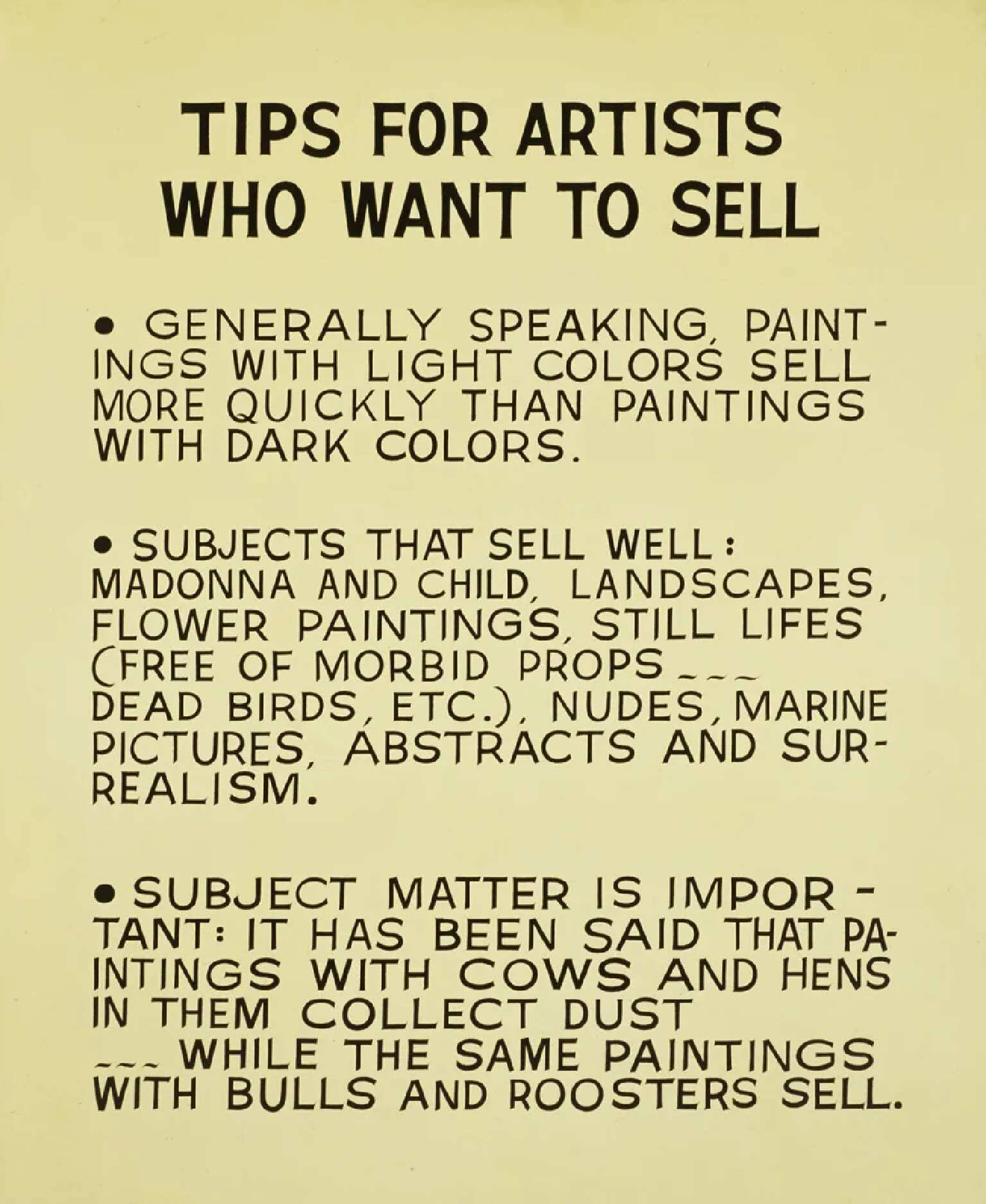
John Baldessari (1931-2020)
Tips for Artists Who Want to Sell, 1966-68
Acrylic on canvas
68 1/4 x 56 1/2 x 1 1/2 in. (173.36 x 143.51 x 3.81 cm)
Why?
You may not be seeking gallery representation or have any interest in it. However it is helpful to understand all the options and how they function. Conversely, you may want to pursue gallery representation, or you have an interest in forming a gallery and courting artists. This chapter addresses how gallery courtships often function and how they escalate.
Required
The Commercial Gallery Courtship, Art/Work
Pages 288–297
Response Questions
Select one question below to which you will respond. Remember to cite specific instances from the text to support your views.
- What most surprised you in this reading set and why?
- How might you go about gaining gallery representation? What’s your game plan? Remember to cite instances from the reading.
Supplementary Readings
These are optional readings to help enrich your understanding of the themes of this reading set.
- Gallery Courtship
-
How Do Artists Get Gallery Representation?, Artsy
“But whether you’re entering the art world as a self-taught creative or an MFA graduate, the road to finding representation can be perplexing. It’s no longer appropriate to stride into a gallery wielding your portfolio, expecting to be discovered—so how do you land on the radar of the galleries you already admire and respect?”
10.1: Loans and Commissions
The Ins and Outs
Read by Mon Nov 03,
Reading Response due Wed Nov 05,
Reading Response due Wed Nov 05,
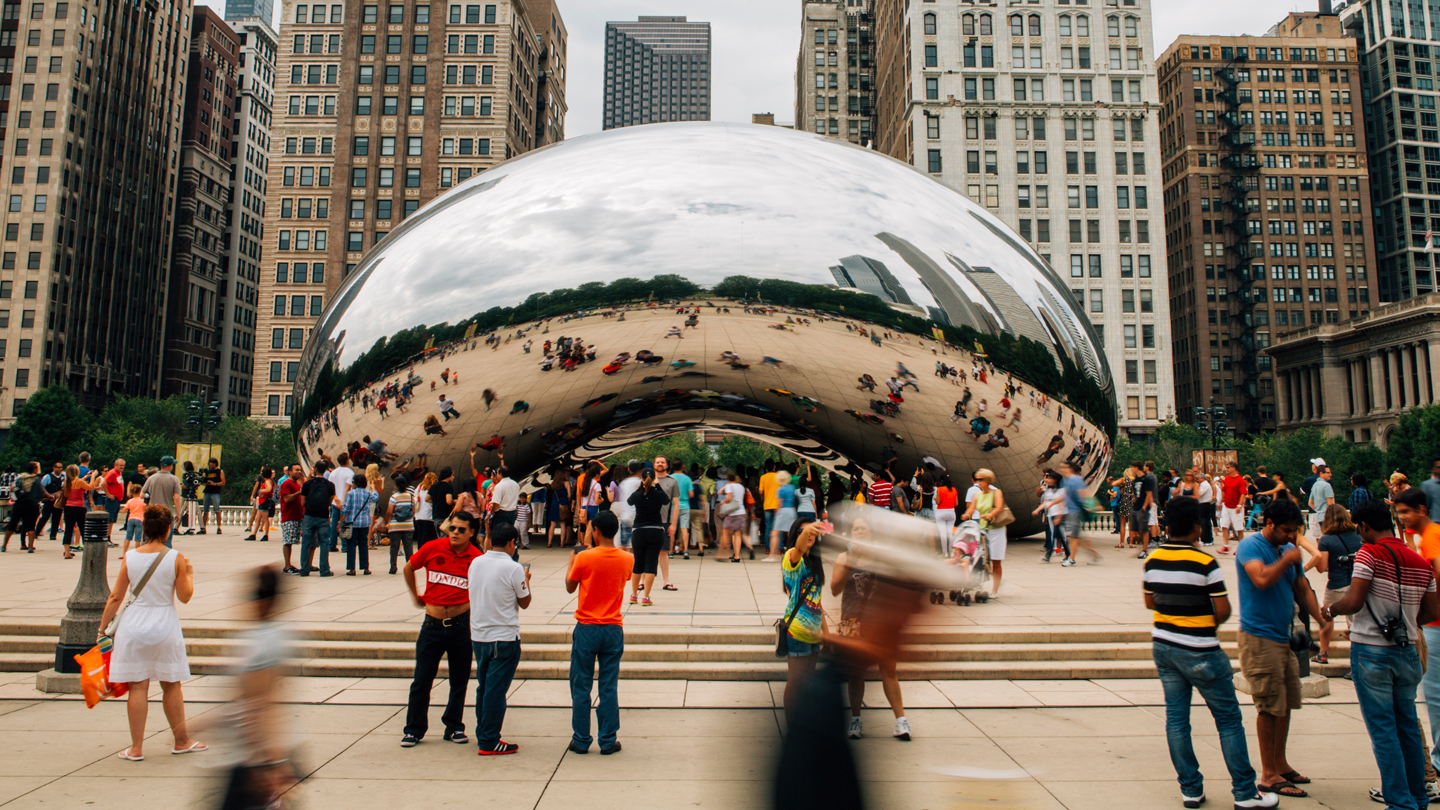
Anish Kapoor (1954–)
Cloud Gate, 2006
Chicago
Why?
Ocassionally you will loan your work for an expectation (which is different then placing it on consignment). There is not expectation of sales. This is typically done for museum or non-profit exhibitions. In addition, another option for your work is that someone may commission you to make work—paying you prior to the work being made. This chapter outlines considerations for these two paths.
Required
Loans and Commissions, Art/Work
Pages 274–285
Response Questions
Select one question below to which you will respond. Remember to cite specific instances from the text to support your views.
- What most surprised you in this reading set and why?
- When accepting money up front, there are some potential snags: the buyer wants more creative control, what if they want to back out of the agreement, what if you want to back out of the agreement. How might you navigate some of these scenarios. Remember to make reference to the readings.
Supplementary Readings
These are optional readings to help enrich your understanding of the themes of this reading set.
- Commissions
-
Ask the Art Professor: How do Artists Handle Commissions?, HuffPost
“Artists are usually excited to get a commission, but most are not prepared for how dicey commissions can be. Commissioned artwork can be anything: a portrait, a wedding gift, artwork for a hotel, etc. Unfortunately, there are no universal rules for art commissions. Consequently, many clients take advantage of artists, so follow these guidelines to protect yourself.”
9.2: Consignments
What Models Are There?
Read by Wed Oct 29,
Reading Response due Wed Oct 29,
Reading Response due Wed Oct 29,
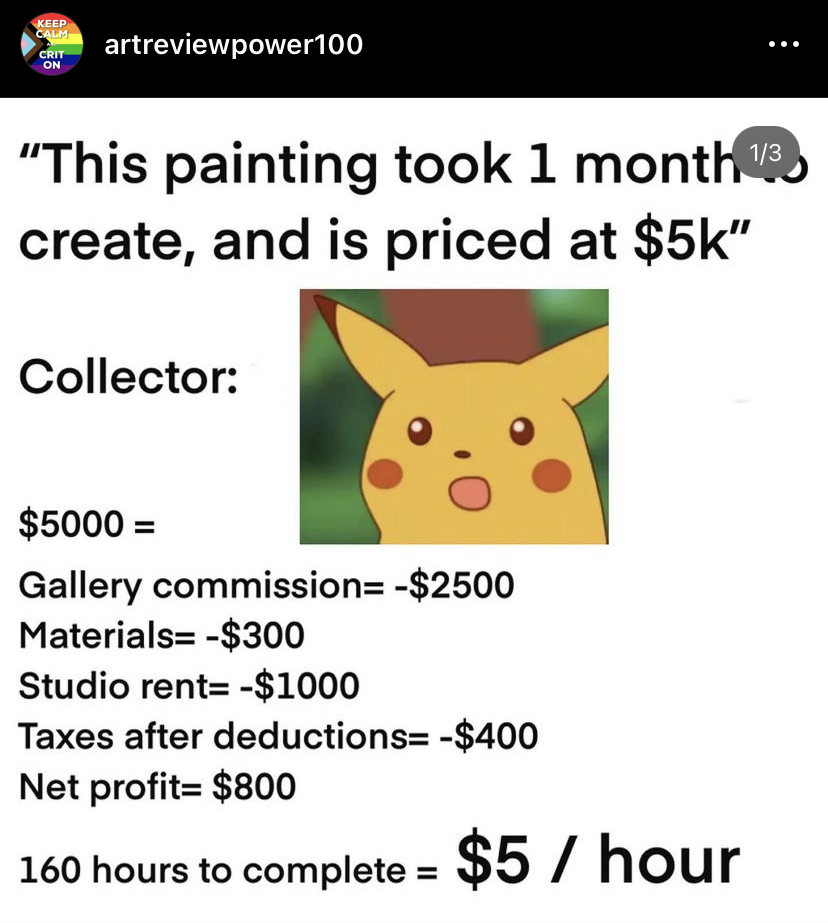
Making money is art and working is art and good business is the best art.
Andy Warhol
Why?
Most gallery sales happen by consignment—you are not paid in advance for the work, but when the work sells, the seller retains a portion of the sale, and returns to you the rest. As such, it is important to understand the nuances of consignment agreements and what to watch out for.
Required
Consignments, Art/Work
This chapter covers the nitty-gritty of consignments—from sales, to discounts, to framing/shipping costs, insurance, and more.
Response Questions
Select one question below to which you will respond. Remember to cite specific instances from the text to support your views.
- What most surprised you in this reading set and why?
- If you don’t plan to sell your work on consignment, what might still apply to your practice from this reading set?
8.2: Getting Your Work to the Show
Get Me to the Church on Time
Read by Wed Oct 22,
Reading Response due Wed Oct 22,
Reading Response due Wed Oct 22,
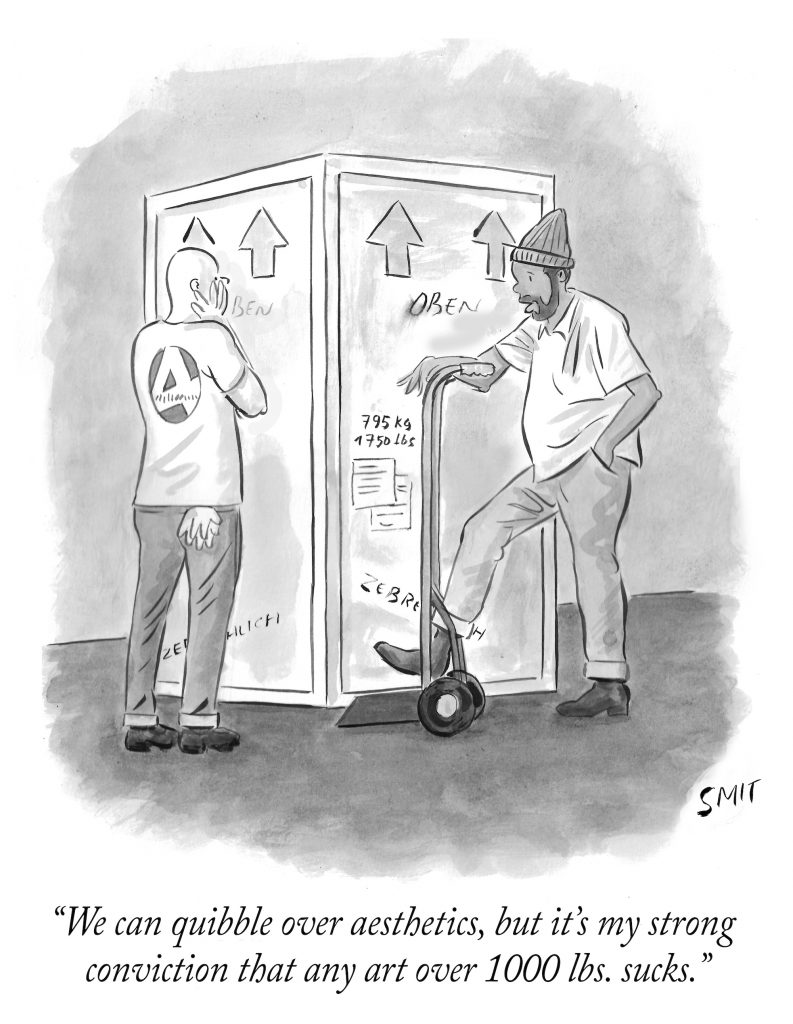
What’s the Fastest Way to Ruin an Art Handler’s Day?, 2022
Why?
You’ve made the work and landed a show. Now what? How do you make sure your work gets there safely, and how do you cover yourself if it doesn’t? The methods outlined in the chapter won’t cover every scenario or type of art, but they are a good starting point and will bring up points that should be considered regardless of size or medium.
Required
Getting Your Work to the Show, Art/Work
Pages 218–237
Response Questions
Select one question below to which you will respond. Remember to cite specific instances from the text to support your views.
- How might this chapter apply to your art practice?
- How do concerns of packing and shipping impact how you might construct your artwork, or if you might abandon a way of working all together?
Supplementary Readings
These are optional readings to help enrich your understanding of the themes of this reading set.
- Art Packing and Shipping
-
Building a Crate
“This video is about how I build a wood shipping crate to ship a large painting by freight truck.”
How to Pack Fine Art into a Crate For Shipping Video
“Your art is precious, unique, and valuable. You have to make sure it gets to its new home safely. In this video, Tanner explains how to pack your fine art safely into a crate for shipping. Join Tanner to learn the process of safely prepping your art for transport.”
Shipping Crate Speedbuild
“Making a custom ship crate for one of my eSports awards. Gotta make these things battering rams in order to survive the rigors of FedEx and UPS.”
How FINE ART is TRANSPORTED
Crate building starts at around 02:33. “This is the process of crating a sculpture of mine for a cross country trek to the Fuller Craft Museum in Brockton, Massachusetts. Having worked in museums for nearly a decade before starting this channel, crate building was one of my favorite parts of that job. Every piece of art is unique, so crate building involves a TON of problem solving. ”
8.1: Rejection
Understanding Rejection From a Perspective Outside Your Own
Read by Mon Oct 20,
Reading Response due Wed Oct 22,
Reading Response due Wed Oct 22,
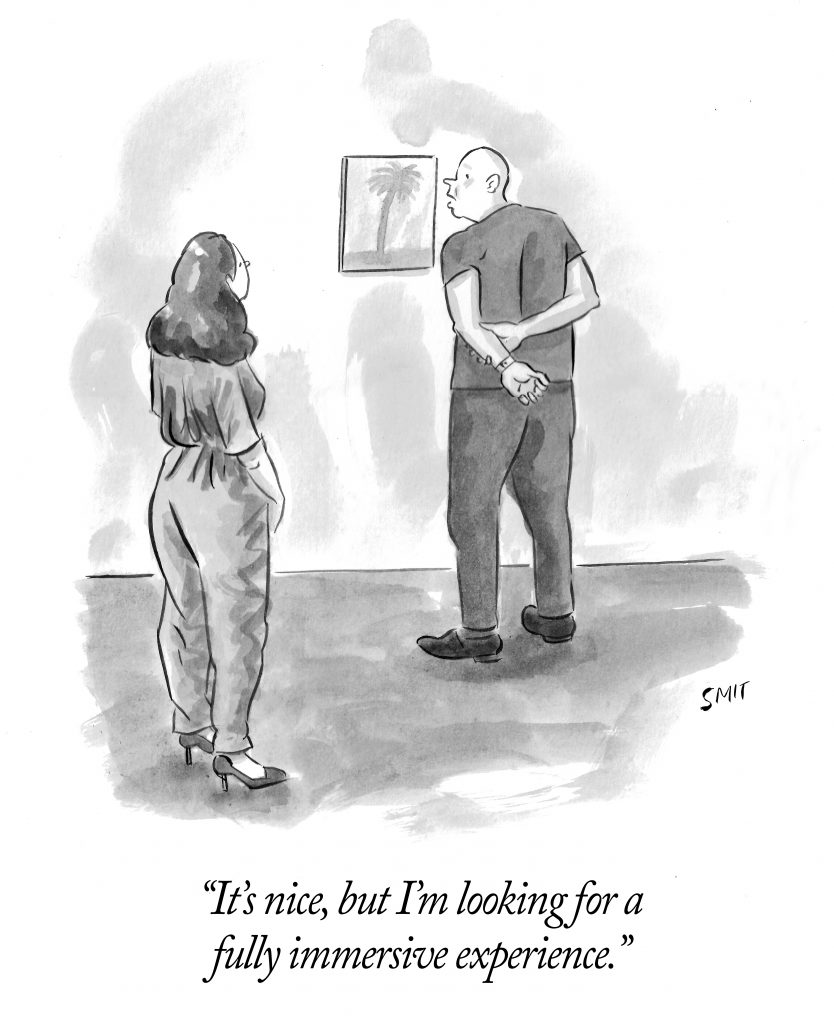
Why Do Paintings Look So Boring Lately?, 2022
Why?
Because of the competitive nature of the art market, and some of the art world, there is a necessary element of rejection. You won’t get every job, every show, every residency. People will tell you no. Sometimes they will do it kindly, with warmth. Sometimes they will be cold and clinical. Sometimes they will be downright cruel. How can artists handle rejection?
Required
Rejection: It’s Not You, It’s Them, Art/Work
Pages 208–215
Response Questions
Select one question below to which you will respond. Remember to cite specific instances from the text to support your views.
- What are some strategies that you think will work for you to handle rejection? Why will they work for you?
- What do you find comforting or helpful from the chapter? Why?
6.1: Showing Your Work
Galleries, Museums, Online, and Other Opportunities
Read by Mon Oct 06,
Reading Response due Wed Oct 08,
Reading Response due Wed Oct 08,
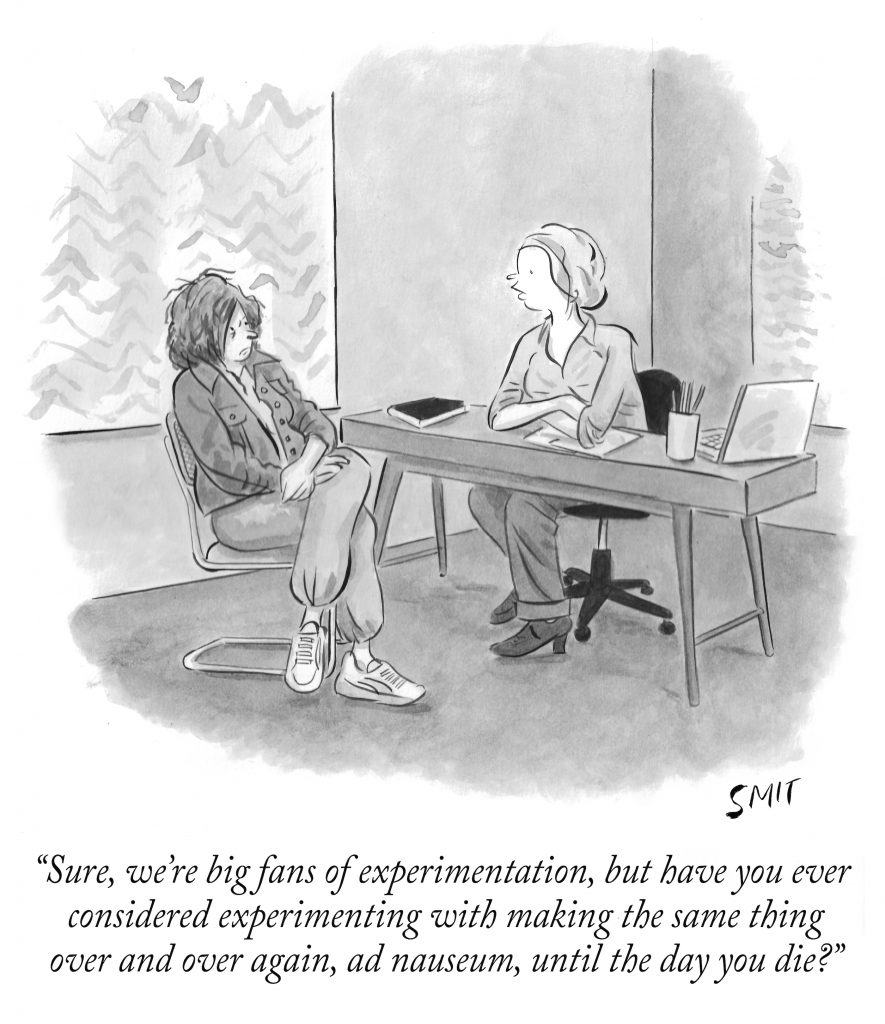
Is It Possible for an Artist to Experiment and Still Make Money?, 2022
Why?
You want to get your work out there. What types of opportunities and venues are there? What is the etiquette when it comes to approaching galleries and curators? What’s the difference between a commercial venue and a non-profit, and what does that mean for the type of work you want to show? What type of research should I do? These are the topics that will be addressed in this chapter.
Required
Showing Your Work, Art/Work
Pages 176–205
Response Questions
Select one question below to which you will respond. Remember to cite specific instances from the text to support your views.
- Which venues/platforms seem like the best fit for you and your work? Why?
- If the traditional gallery frameworks seems like a bad fit for you, what might be alternate paths for you? In what ways will they not work for you? How might you get your work out there outside of the opportunities outlined in the chapter.
Supplementary Readings
These are optional readings to help enrich your understanding of the themes of this reading set.
- Getting into Exhibitions
-
Ask the Art Professor: How Can I Get Into Art Exhibitions?, HuffPost
“When I was at the very beginning of my career I had no exhibition history to speak of, so I had to start somewhere. Beginning locally seemed to be the most accessible way into exhibitions, so I looked online for local juried exhibitions that I could enter, and spent a lot of money on entry fees. I was not selective about where I showed my work. Anywhere anyone would exhibit my work, I jumped at the opportunity. This strategy was effective in terms of raising my local visibility and building my resume, which is essential when you're just getting started. I exhibited my work at all sorts of contrasting venues: an office building, local art centers, a gallery that was in a subway station, open studios and many others. Don't be shy and be sure to attend the opening reception of every exhibition you're in to meet the other artists, the gallery director and the juror in person. This is a great way to network with other artists and get your name out there on the local art scene.”
5.1: Sustaining Your Practice (with Money and Stuff)
How To Identify and Capture Opportunities
Read by Mon Sep 29,
Reading Response due Wed Oct 01,
Reading Response due Wed Oct 01,
Artoons, 2009
Why?
Money, money money. It’s a necessary commodity. How do you get it as an artist? This chapter discusses grants, residencies, crowdfunding, bartered support, earned support, and licensing. All are interesting ways to support an artistic practice, and can be part of a larger palette of options. Sales will be covered in more detail in later chapters.
Required
Sustaining Your Practice (with Money and Stuff), Art/Work
Pages 132–173
Response Questions
Select one question below to which you will respond. Remember to cite specific instances from the text to support your views.
- Outline a list of potential revenue sources for your near-future practice (not five years down the road, but starting now, and leading you over the next few years). Why did you indicate the revenue sources you did?
- Do you see income from your art or a creative practice as central to your view of your life after school? Explain. If not, what do you see as the means of sustaining your life and lifestyle? If you do see income from your art as central, what avenues will make that happen?
- What were the most surprising elements of this reading set? Why did you find them surprising?
Supplementary Readings
These are optional readings to help enrich your understanding of the themes of this reading set.
- Art Pricing
-
Ask the Art Professor: How Do You Price Art?, HuffPost
“The artist's position in the art world is probably the most important aspect to consider. Emerging artists haven't developed a name yet, so they can't demand thousands of dollars for a single artwork. The majority of emerging artists will usually sell an oil painting within the $100-$1,000 range. An artist who can sell an oil painting for $30,000 would be considered by most people to be very successful. Then there's the top of the art world where some artists can sell an oil painting for $500,000 and more. These artists are the select few who are internationally renowned and showing at the top museums.”
- Residencies
-
EP 37: Your Ultimate Artist Residency Guide, Art Problems
“Do you really need an artist residency? You know it helps a CV, but how much? Will it help other aspects of your career? In this episode, I talk about how to determine if you need a residency and how to find the residencies best suited to your needs. If you've been stressing over whether you should spend time at a residency or how to find one, this podcast will provide an answer to many of those anxieties.”
4.2: Opening Your Studio
And What Do You Do Without a Studio?
Read by Wed Sep 24,
Reading Response due Wed Sep 24,
Reading Response due Wed Sep 24,
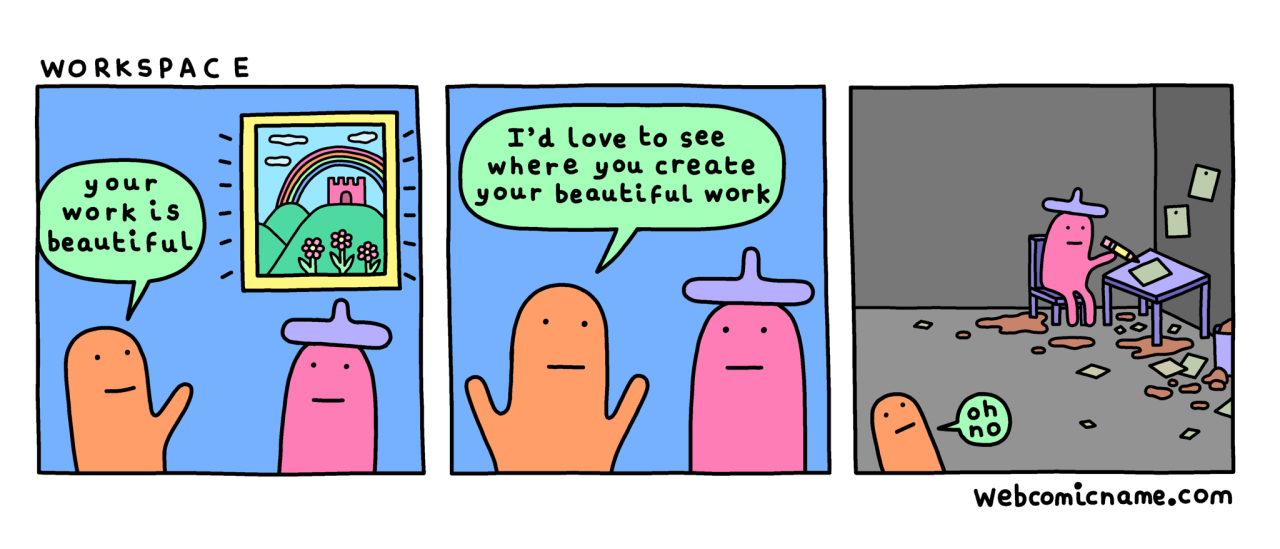
Webcomic Name: Workspace, May 18, 2023
Why?
You want to start getting more opportunities for your art. What do you do? One option is to invite people to see your work at exhibitions, your studio, and other pertinent locations. You’ll want to set reasonable expectations for these visits and think about how you frame these appoitnments. You don’t want to invite a curator to your studio without explaining the purpose of the visit, or how it will operate. That puts the onus of the visit on your visitor, which makes you a poor host. This chapter discusses group visits, individual visits, curatorial visits, open studios, portfolio reviews, and introduces art sales, which will be covered in more depth in later chapters.
Required
Opening Your Studio, Art/Work
Pages 108–129
Response Questions
Select one question below to which you will respond. Remember to cite specific instances from the text to support your views.
- If you see yourself as a post-studio artist, or don’t have a traditional studio space, how might you still facilitate some of these “studio visit” opportunities without a studio? What are analogous situations you can foster?
- What were the most surprising elements of this reading set? Why were they surprising to you?
- How does this chapter shape the way you think about our semesterly open studios for BFA and BA students? How might you approach those differently?
Supplementary Readings
These are optional readings to help enrich your understanding of the themes of this reading set.
- Studio Visit Etiquette
-
How to Nail the Studio Visit: Expert Advice on What Artists Should Do (and Not Do) to Make an Impression, Artspace
“So what should you, as an artist, do to prepare for a studio visit? We’ve asked dealers, curators, advisors, collectors, and seasoned artists to provide some insider insight on what to do (and what not to do) during your next studio visit. Here’s what the experts had to say.”
How to Nail the Studio Visit, Pt. 2: Easy Rules for Not Making the Artist Think You’re a Crazy Person, Arspace
“Here, we’ve asked artists (and some curators and advisors) about the annoying things that visitors do during studio visits, and what advice they’d give to people preparing for their next meeting with an artist. If you’re a curator, collector, advisor, or dealer, do yourself a favor and read this guide—your artist-hosts will thank you for it.”